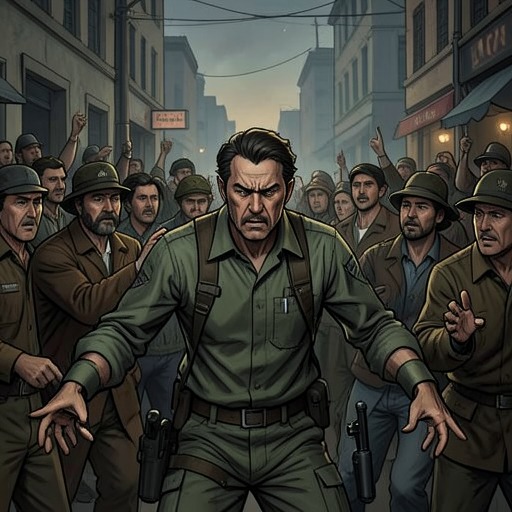
Thomas Birdsey’s hand amputation
I Know This Much Is TrueThomas Birdsey’s hand amputation is presented as a religiously charged act against the destruction of war and, at the same time, as an attempt to impose order on a world Thomas experiences as chaotic. Its consequences reach beyond the bodily injury: the act becomes a source of public attention, a painful subject in Dominick Birdsey’s conversations with Dr. Patel, and a test of how his brother’s behavior can be understood without diminishing its harm.
The Act and Its Stated Purpose
The amputation took place in a library. In discussing it afterward, Dr. Patel asks whether Thomas removed his hand as a sacrifice, with the aim of stopping the destruction war inevitably brings. The account gives the act a religious frame—Dominick describes it as Thomas cutting his hand off for Jesus—but does not present the religious explanation as making the injury less shocking or less consequential.
Dr. Patel offers a further interpretation: Thomas is struggling to cure himself of what she identifies as his gravest fear, chaos. In her account, the wish to order the world and save it is bound to the wish to save himself. The act therefore carries two connected aims, one directed outward at war and one inward at Thomas’s own distress. The evidence establishes this as Dr. Patel’s interpretation, rather than a settled explanation that Dominick accepts.
The Recorded Thumping
A tape played during a later conversation contains an indistinct, staccato thumping sound. Dominick recognizes it as Thomas striking his stump against something. Dr. Patel confirms that Thomas had hit it against the table where they were seated, briefly and to make his point. The sound turns a discussion of the amputation into an immediate encounter with its aftermath: Thomas’s injured body is not merely being described but is heard making a forceful gesture during the recorded exchange.
The moment also resists a simple division between speech and action. Thomas makes his point through the stump, while the tape preserves the noise without identifying it until Dominick understands what he is hearing. Dr. Patel’s brief clarification gives the sound a concrete source and circumstance; Dominick’s recognition gives it emotional force. The record makes the injury present again in a form that is at first obscure and then unmistakable.
Dominick’s Anger and the Public Aftermath
Dr. Patel asks Dominick to consider the possibility that Thomas’s struggle is noble. Dominick rejects that reading. He focuses instead on the library act’s extremity and on the attention it brings: he complains that Thomas has attracted media figures, including a call from Connie Chung, and the interest of a New York booking agent. His response makes the public consequences inseparable from his private distress. The event has become something other people want to cover or represent, while Dominick is left confronting what his brother did and what it means for their family.
Dominick’s anger appears again when he raises his voice and contrasts ordinary library use—checking out books—with Thomas cutting off his hand for Jesus. He connects the act to calls and media attention, then breaks off before finishing his thought. The interruption leaves his frustration exposed but unresolved: he is not persuaded by the language of sacrifice, and the attention surrounding Thomas’s act adds another burden rather than offering him comfort.
Competing Interpretations
The amputation is thus recalled through sharply different emphases. Dr. Patel sees a very sick man who is also good, and understands the sacrifice as an attempt to resist war and overcome chaos. Dominick sees the catastrophic act, its bodily aftermath, and the public spectacle that follows. His skepticism does not disprove Dr. Patel’s interpretation; it shows how difficult that interpretation is to accept from the position of a brother facing the consequences.
The event’s force comes partly from that unresolved tension. The religious and antiwar purpose does not erase the injury, while the injury does not by itself settle what Thomas was trying to accomplish. The later tape and Dominick’s outburst return the reader to the act from different angles: first as a mission to save the world and himself, then as an unbearable event that has drawn strangers’ attention. The amputation remains both a bodily crisis and a point of conflict over whether Thomas’s sacrifice can be called noble.